
Microsoft and AMD Unlock Faster 4K AI Upscaling on Xbox Series X Than Comparable RDNA 2 GPUs
Published November 14, 2026, 3:30 PM
Updated November 14, 2026, 3:01 PM
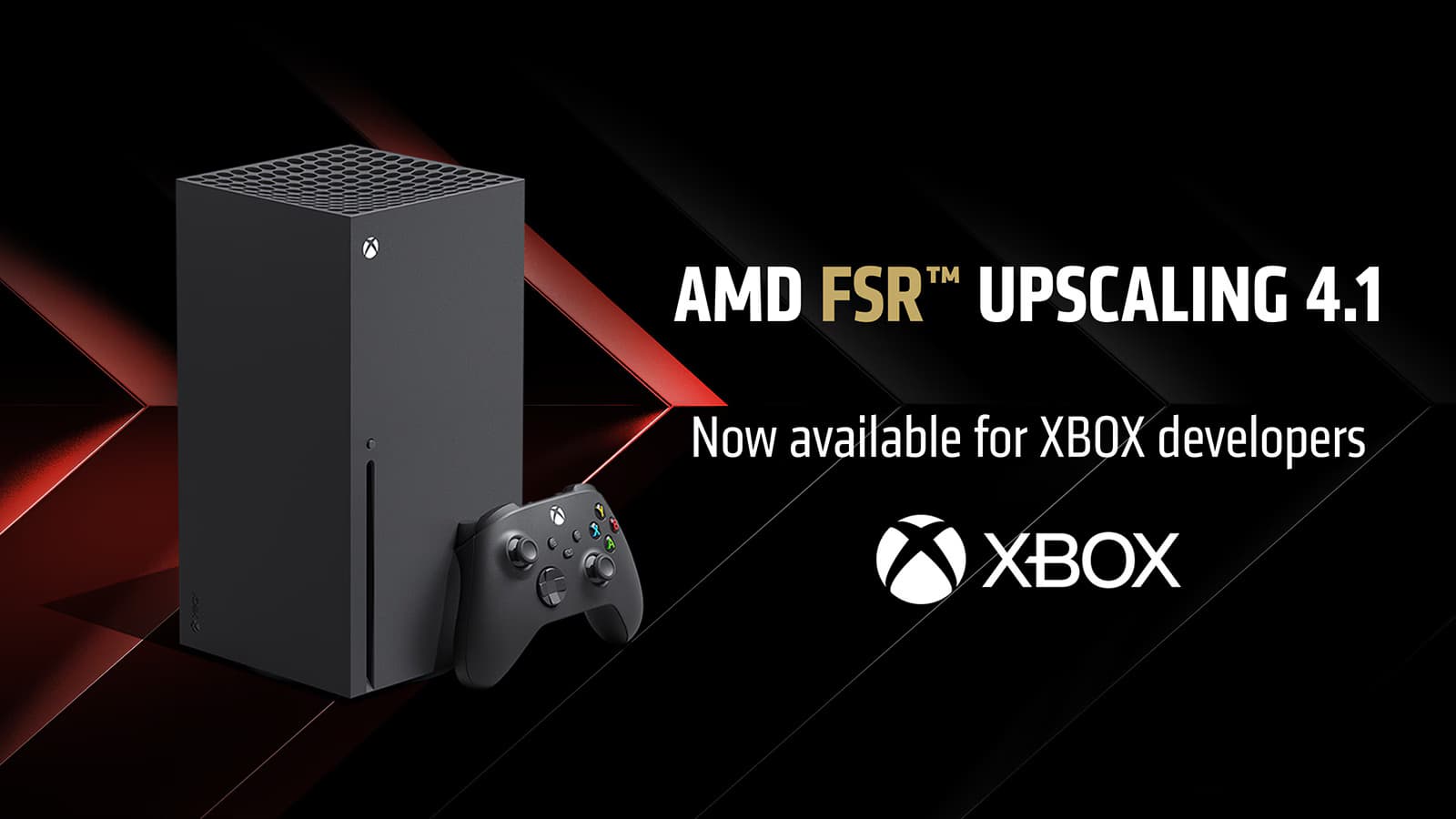
The Xbox Series X processes AMD’s machine-learning FSR 4 upscaling roughly 30 percent faster than a comparable desktop graphics card with higher theoretical compute power, according to independent testing by Digital Foundry alongside official console telemetry from Microsoft.
In benchmarks comparing Microsoft’s newly released developer sample at 4K Balanced output, the six-year-old console completed AMD’s full FSR 4.1.2 upscaling pass in 3.86 milliseconds, compared with roughly 5.0 to 5.2 milliseconds on a desktop AMD Radeon RX 6700 XT. The result highlights how fixed console memory bandwidth and low-level software tuning can outweigh raw shader clock speeds on aging graphics silicon.
AMD and Microsoft rolled out FSR Upscaling 4.1.2 to Xbox Series X and Series S studios on November 4 through the October 2026 Microsoft Game Development Kit, weeks after AMD brought INT8-based FSR 4.1 support to desktop Radeon RX 6000 cards. Originally launched in 2025 as an exclusive feature for RDNA 4 graphics cards using specialized FP8 matrix hardware, FSR 4 was adapted by AMD into an INT8 neural model so older RDNA 2 hardware without dedicated AI matrix cores could run machine-learning image reconstruction.
Alongside the console release, Microsoft published a cross-platform GDK sample featuring a Sponza palace scene populated with volumetric fog, particle effects, and a Tyrannosaurus rex model. The sample runs on both Xbox hardware and Windows PCs, allowing engineers to toggle between analytical FSR 3 and the new Full and Lite INT8 neural models.
Digital Foundry’s Richard Leadbetter ran the Windows build of Microsoft’s sample on a Radeon RX 6700 XT, widely treated as the closest desktop relative to the Series X GPU, and compared those measurements against Microsoft’s published Series X dispatch times. Tested at 4K output using Balanced mode, which renders internally at roughly 1270p before reconstructing the final frame, the Xbox Series X held a clear lead across every configuration.
Microsoft GDK Sample: Xbox Series X|S vs. Radeon RX 6700 XT (4K Balanced)
| Platform / Hardware | Upscaling Model (INT8) | Output Resolution | Upscaler Dispatch Time |
|---|---|---|---|
| Xbox Series X | FSR 4.1.2 Full | 4K | 3.86 ms |
| Radeon RX 6700 XT | FSR 4.1.2 Full | 4K | ~5.0–5.2 ms |
| Xbox Series X | FSR 4.1.2 Lite | 4K | 2.75 ms |
| Radeon RX 6700 XT | FSR 4.1.2 Lite | 4K | 3.11 ms |
| Xbox Series X | FSR 4.1.2 Full | 1440p | 1.95 ms |
| Xbox Series X | FSR 4.1.2 Lite | 1440p | 1.29 ms |
| Xbox Series S | FSR 4.1.2 Full | 1080p / 1440p | 2.9 ms / 5.2 ms |
| Xbox Series S | FSR 4.1.2 Lite | 1080p / 1440p | 1.9 ms / 3.4 ms |
The gap widened further when optional image sharpening was enabled. Adding sharpening increased the Series X upscaling cost by roughly 4 percent, whereas the RX 6700 XT saw an increase of about 10 percent, pushing its total pass time to roughly 5.5 milliseconds. Digital Foundry also recorded memory overhead on PC at approximately 318 MB for 4K output and 81 MB at 1080p, broadly in line with analytical FSR 3—and AMD’s GPUOpen documentation notes that memory footprint remains identical between the Full and Lite models because allocation depends solely on render and display resolutions.
On raw specification sheets, the Radeon RX 6700 XT holds a slight edge in peak compute. Built on AMD’s Navi 22 silicon with 40 compute units boosting up to 2.58 GHz, the desktop card delivers roughly 13 TFLOPS of peak FP32 compute and around 53 trillion INT8 operations per second (TOPS). The Xbox Series X pairs 52 RDNA 2 compute units running at a fixed 1.825 GHz for 12 TFLOPS of FP32 throughput and roughly 49 TOPS of INT8 compute.
Two architectural and software advantages flip that equation during an AI upscaling pass. First, the Xbox Series X’s primary 10 GB graphics memory pool operates at 560 GB/s across a wider memory interface, offering nearly 46 percent more raw memory bandwidth than the RX 6700 XT’s 384 GB/s bus. While the desktop card compensates for its narrower bus in traditional rasterization with 96 MB of Infinity Cache, neural network inference passes frequently stream large intermediate feature buffers that benefit directly from sustained memory bandwidth.
Second, Microsoft engineered its 2020 console silicon specifically with low-precision machine learning in mind. As Microsoft technical fellow Andrew Goossen detailed ahead of the console’s launch, the Series X custom GPU incorporates hardware acceleration for 8-bit and 4-bit integer operations. Combined with direct, console-specific tuning in the October 2026 GDK—bypassing Windows driver abstraction layers and distributing work across 52 compute units instead of 40—Microsoft and AMD extracted substantially higher real-world efficiency from the console.
“Working closely with AMD, the Xbox team has optimized AMD FSR Upscaling 4 for Xbox Series X|S, making ML-based upscaling practical on the consoles’ RDNA 2-based GPUs,” Claude Marais, principal software engineering lead at Team Xbox, wrote in the November 4 developer announcement.
Even at 3.86 milliseconds, FSR 4.1.2 carries meaningful scheduling constraints for studios. In a game targeting 60 frames per second, the entire GPU and CPU workload must finish within 16.67 milliseconds, meaning a 4K Full upscaling pass alone claims roughly 23 percent of the frame budget. For comparison, Digital Foundry has previously measured Sony’s lightweight QSSR upscaler on the base PlayStation 5 at roughly 4.4 milliseconds for 4K output, while the PlayStation 5 Pro’s dedicated PSSR hardware completes a 4K pass in about 2 milliseconds.
As a result, studios targeting 60 frames per second on Series X are more likely to lean on the 4K Lite model—which cuts upscaling time by nearly 29 percent to 2.75 milliseconds and trims neural model size by more than half—or output at 1440p, where the Full model costs 1.95 milliseconds. On the lower-powered Xbox Series S, where 1440p Full costs 5.2 milliseconds, the 1.9-millisecond 1080p Lite pass offers a far more viable route to cleaning up the temporal shimmer and soft motion common in earlier FSR 2 and FSR 3 titles.
Unlike Windows PCs, where AMD’s Adrenalin 26.10.1 driver lets players automatically upgrade supported DirectX 12 games from FSR 3.1 to FSR 4.1, Xbox consoles do not offer a system-level override. Existing games must be patched by developers, while upcoming titles must integrate the October 2026 GDK binaries natively using AMD’s unified FSR SDK headers.
Attention has quickly turned to Grand Theft Auto VI, scheduled to launch on consoles on November 19. Dataminers examining Xbox package metadata recently identified two libraries—amd_fidelityfx_loader_xbox.dll and amd_fidelityfx_upscaler_xbox.dll—that match the file naming convention in Microsoft’s FSR 4.1.2 GDK sample. However, AMD’s unified FidelityFX SDK uses the same loader architecture for analytical FSR 3.1.6 as well as FSR 4.1.2, and Rockstar Games has not confirmed whether Grand Theft Auto VI will ship with machine-learning upscaling enabled on Xbox. Industry reporting from Windows Central indicates a small number of partner titles could adopt FSR 4.1 before the end of the holiday season, with broader studio adoption expected through 2027.