Team Yandex beat LGD Gaming 3-1 in Copenhagen to claim BLAST Slam VII and their third Tier 1 title this season. Here’s what it means for TI 2026.
Published June 8, 2026, 12:44 PM
Updated June 8, 2026, 12:45 PM
Picture Credits : BLAST Esports
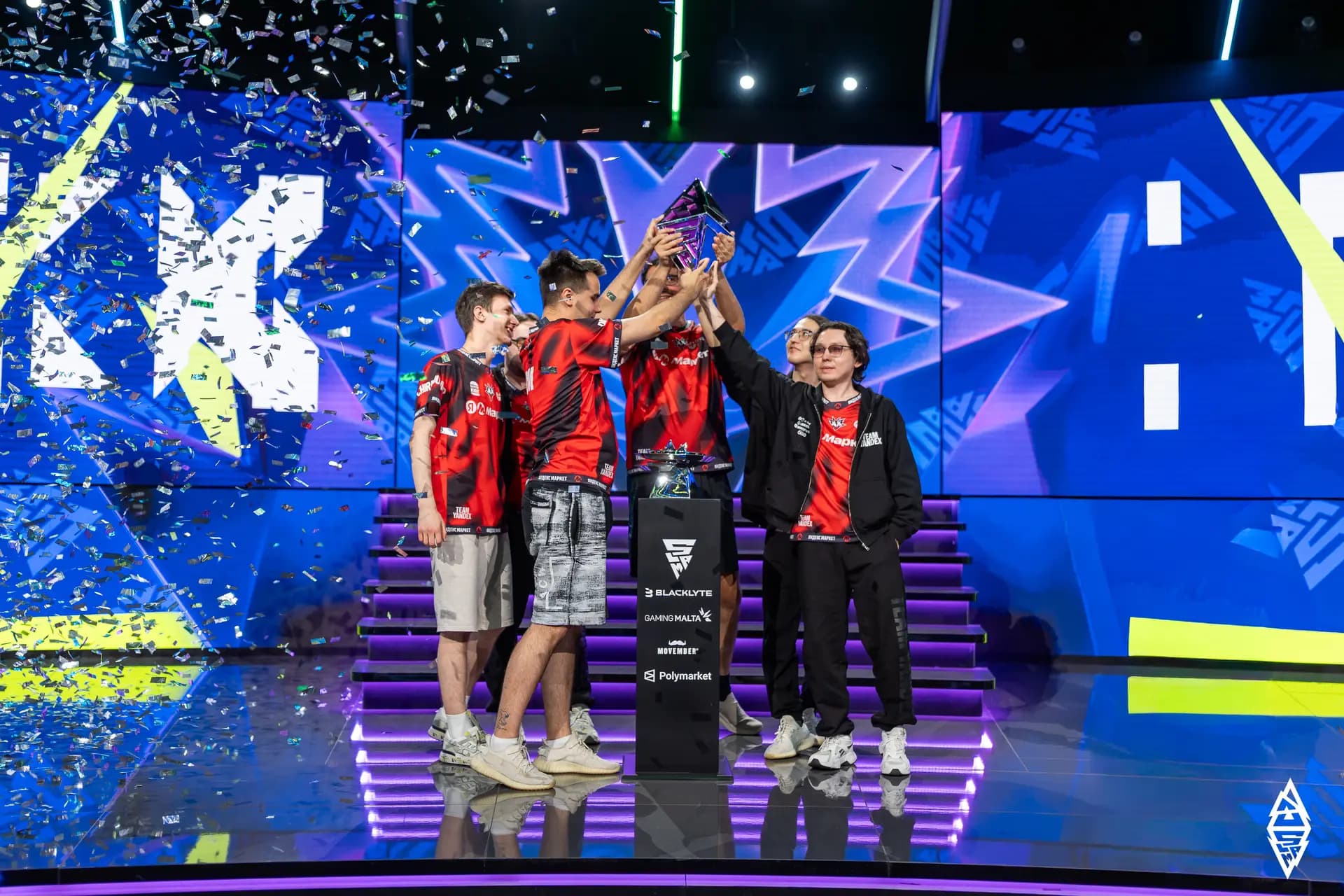
Team Yandex claimed the BLAST Slam VII championship on Monday, June 8, defeating LGD Gaming 3-1 in the grand final at BLAST Studio in Copenhagen, Denmark, to secure their third Tier 1 tournament title.
Quick Facts:
No active Dota 2 roster in the current circuit cycle has won three Tier 1 events in a single season. With their victory at BLAST Slam VII, Team Yandex now hold three Tier 1 tournament titles in the 2025-2026 season, a mark that sets them apart from every other team heading into the final stretch of the year.
The sequence is worth naming plainly: Yandex won DreamLeague Season 27 in December, PGL Wallachia Season 7 in March, and now BLAST Slam VII in June. That is three elite-tier trophies across six months, across different formats, and against different finalist opponents each time.
Alimzhan “watson” Islambekov averaged 9.3 kills, 1.8 deaths, and 9.3 assists across all four games of the grand final, making him the statistical standout of the series. But the story of this Yandex squad is not one player – it is the depth of their individual performers across every role.
The prize economics reflect the weight of the result. Yandex claimed the grand prize of US$400,000, split between US$300,000 for the players and US$100,000 for the organization, from a total BLAST Slam VII prize pool of US$1 million.
BLAST Slam VII’s bracket structure adds context to the title. Yandex did not coast in. They finished the Group Stage with a 7-4 record, which was not enough to guarantee a Playoff spot. They had to win their way through the Last Chance Qualifier, defeating Team Spirit to earn a berth in the upper bracket quarterfinals.
The competitive picture shifted dramatically before the Playoffs even began. PARIVISION, considered the biggest favorites to win BLAST Slam VII, were forced to withdraw from the Playoffs due to visa issues. Their upper bracket semifinal slot went to BetBoom Team. It handed the remaining field a genuinely open bracket – but Yandex earned what followed regardless.
From their entry point, Yandex swept Aurora Gaming in the upper bracket quarterfinals, beat LGD Gaming 2-1 in the upper bracket semifinals, and defeated BetBoom Team 2-1 in a reverse sweep to reach the grand final as the first qualifier. That is five Playoff series won without a single defeat across the double-elimination bracket.
The grand final itself produced one moment of genuine tension. After Yandex dominated games one and two and appeared on course for a sweep, LGD’s Adrian “Wisper” Cespedes Dobles engineered a remarkable fightback in game three using Dark Seer’s Vacuum to repeatedly catch multiple Yandex heroes simultaneously, forcing the series to game four after 52 minutes.
Yandex shut the door in game four without hesitation. They closed out the championship in 31 minutes, with watson’s Shadow Fiend and Dmitry “DM” Dorokhin’s Necrophos combining for 18 kills and 11 assists in what was the most one-sided game of the series.
The LGD Gaming story running parallel to Yandex’s triumph deserves its own frame. This is an organization returning to Dota 2 competition after a two-year absence. LGD re-entered the scene by signing the South American roster formerly known as ex-HEROIC, just days before BLAST Slam VII began.
The roster had essentially just been released by HEROIC – an organization that publicly cited Dota 2 as financially unsustainable before exiting the title entirely. LGD picked them up, rebranded them, and sent them to Copenhagen almost immediately.
LGD finished the Group Stage as the top seed with an 8-3 record and earned a direct upper bracket semifinal berth. They produced two separate 111-minute games across the tournament – one in the Group Stage against Yandex, another in the lower bracket semifinals against Aurora. That endurance under pressure from a freshly assembled squad is something no tournament preview predicted.
Wisper posted a 10.7-3.3-14.7 average K-D-A across the lower bracket final against BetBoom, confirming his status as the engine of LGD’s comeback run. He is the player to watch as this roster builds toward the next cycle.
The risk for LGD now: they hold no direct invite to The International 2026. LGD will need to battle through South America’s regional qualifiers to secure a spot at TI in Shanghai later this year – a gauntlet that will test whether the organizational backing of the LGD brand translates into genuine SA qualifier dominance, or whether the roster’s ceiling has already been exposed.
The BLAST Slam VII result lands at a structurally critical moment. This is the last major Tier 1 Dota 2 tournament before teams compete at the Esports World Cup 2026 in Paris and then The International 2026 in Shanghai.
Yandex are among the seven teams to receive direct invites to TI 2026, so BLAST Slam VII carries no qualification consequence for them in the strict sense. But the psychological and preparation value of arriving at EWC on a tournament win – after the most productive individual season any team has assembled this cycle – is not trivial.
The full BLAST Slam VII prize distribution, per Field Level Media’s official tournament report:
PARIVISION’s visa-forced withdrawal from the Playoffs is a subplot that could echo at TI. A team of their caliber missing an entire playoff bracket because of travel document complications represents a real operational gap. If that issue persists into TI 2026’s offline format, their presence at the world championship – despite their direct invite status – becomes a genuine unknown.
The more pressing question: can any team in the field actually beat Yandex across a best-of-five when it matters most? Three times this season, in three different finals, the answer has been no.
Yes. Yandex are among the seven teams confirmed to receive direct invites to The International 2026, meaning their BLAST Slam VII victory carries no bearing on TI qualification. They enter as one of the pre-seeded competitors in the TI 2026 bracket.
Not automatically. LGD Gaming must go through South America’s regional qualifiers to secure their spot at TI 2026 in Shanghai. Despite their BLAST Slam VII runner-up finish, they hold no direct invite at this time.
Based on the current 2025-2026 season standings tracked by GosuGamers and Liquipedia, no other active roster has won three Tier 1 tournaments in this single competitive cycle – making Yandex’s triple of DreamLeague Season 27, PGL Wallachia Season 7, and BLAST Slam VII the benchmark performance of the year heading into TI 2026.